When Chinese painting no longer depicts recognizable landscapes, can the spirit of Chinese landscape still remain?
Traditional Chinese landscape painting is ultimately concerned with yijing—a realm of experience that extends beyond what is visibly depicted. Technique is necessary, but technique alone cannot create this realm.
Over the years, Chinese ink painting has undergone countless formal experiments: splashed ink, heavy color, linear abstraction, layered washes, and increasingly expressive uses of brush and ink. Yet changes in technique do not necessarily constitute a new artistic language. A genuine transformation must occur at a deeper level—in how the artist perceives, understands, and enters the world.
Some viewers assume that my paintings are spontaneous or even randomly made. But freedom with brush and ink is possible only after decades of training in traditional Chinese landscape painting.
There is another kind of painter who may possess strong traditional technique yet still cannot paint freely. The obstacle is no longer technical. It is that the mind has not yet released itself from the structures and expectations of tradition. Without that release, spontaneity cannot truly emerge.
In my Senxiang works, traditional landscape remains present, but no longer necessarily as recognizable mountains, rivers, trees, or clouds.
During the process of painting, I gradually reduce and dissolve these specific forms. Yet I cannot eliminate them entirely through deliberate design. If the work becomes too calculated, it turns into another kind of abstraction. If the underlying consciousness of landscape disappears altogether, the painting risks becoming arbitrary.
This is the tension in which Senxiangism exists.
Landscape Without Landscape
For me, landscape has never been simply a subject to depict.
After decades of painting mountains and rivers, landscape gradually became an internal structure—a way of perceiving space, movement, rhythm, emptiness, density, and the relationship between human beings and the natural world.
At a certain point, I began to ask:
Must a painting contain the image of a mountain in order to retain the experience of landscape?
My answer increasingly became no.
A mountain may disappear as an image while remaining as spatial tension. Water may disappear as a recognizable form while remaining as movement. Clouds may no longer be painted, yet breath and atmosphere may still move through the work.
What disappears is the outward form of landscape.
What remains is its inner consciousness.
Between Control and Surrender
Senxiangism is therefore not simply an attempt to turn Chinese landscape painting into abstraction.
Nor is it an abandonment of traditional Chinese painting.
On the contrary, I see it as something that has grown from within that tradition.
The brush, ink, water, paper, mineral pigments, and the accumulated experience of Chinese painting remain fundamental to my practice. But I no longer want these materials merely to reproduce established forms.
I allow ink, water, color, paper, pressure, gravity, absorption, and chance to participate in the creation of the image.
The painting begins to generate itself.
Yet this does not mean that the artist disappears.
The greatest difficulty lies precisely in knowing when to intervene and when to withdraw; when to control and when to allow the materials to move beyond control.
Too much intention suffocates the painting.
Too little judgment turns freedom into randomness.
I work between these two states.
What I sometimes call “flow” is not the absence of discipline. It is what becomes possible after discipline has been absorbed so deeply that conscious calculation can temporarily recede.
The hand moves before explanation.
Judgment remains, but it has become instinctive.
What Remains After Form?
This is why I believe Senxiangism is fundamentally conservative in one sense, yet entirely rooted in the present.
Its materials cannot simply be abandoned.
Its relationship to Chinese landscape cannot simply be abandoned.
Its understanding of brush and ink cannot simply be abandoned.
But neither can tradition remain fixed.
Tradition survives only when it continues to generate something that belongs to the present.
For me, the purpose is not to preserve the appearance of traditional landscape painting.
It is to ask whether something deeper can survive after that appearance has disappeared.
If mountains, rivers, trees, and clouds are no longer clearly depicted, yet the viewer can still enter the painting as one might enter a landscape—wandering, pausing, losing direction, discovering space, and sensing the movement of life—then perhaps landscape has not disappeared at all.
Perhaps it has simply moved from the visible world into another realm.
And perhaps this is where Senxiang begins.
— Chen Jiuteng, 2026
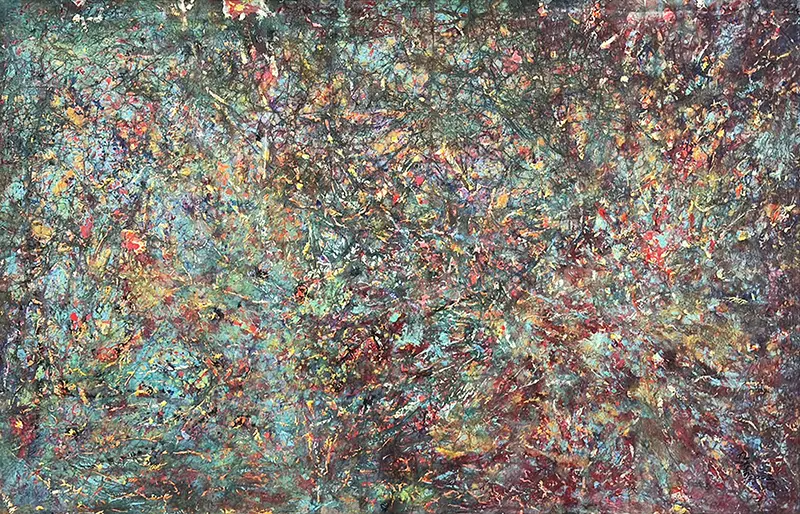
The Web of Life, 2025
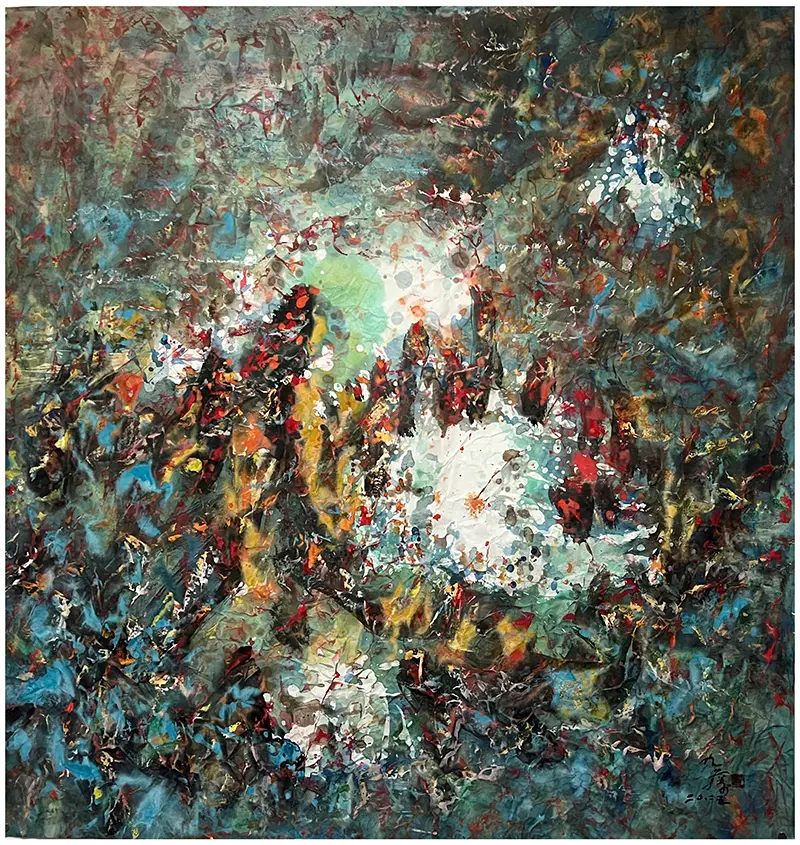
Beyond Knowing, 2025
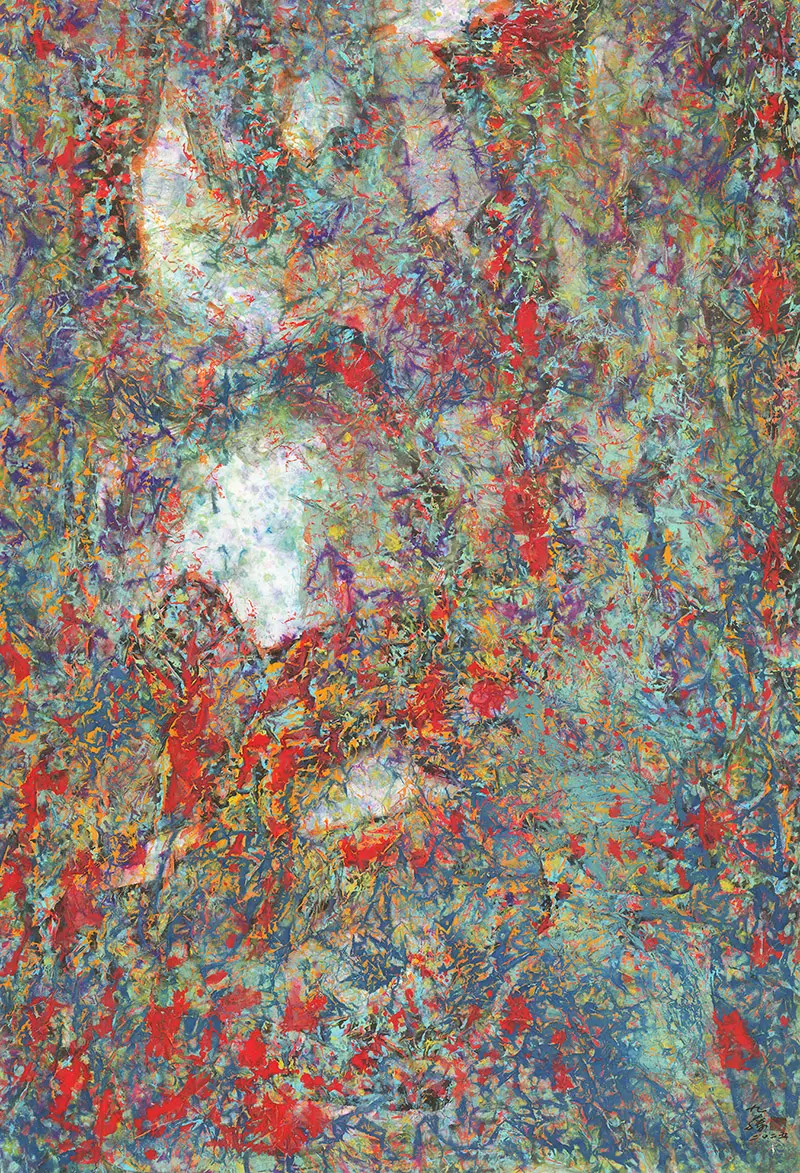
Myriad Becoming, 2025
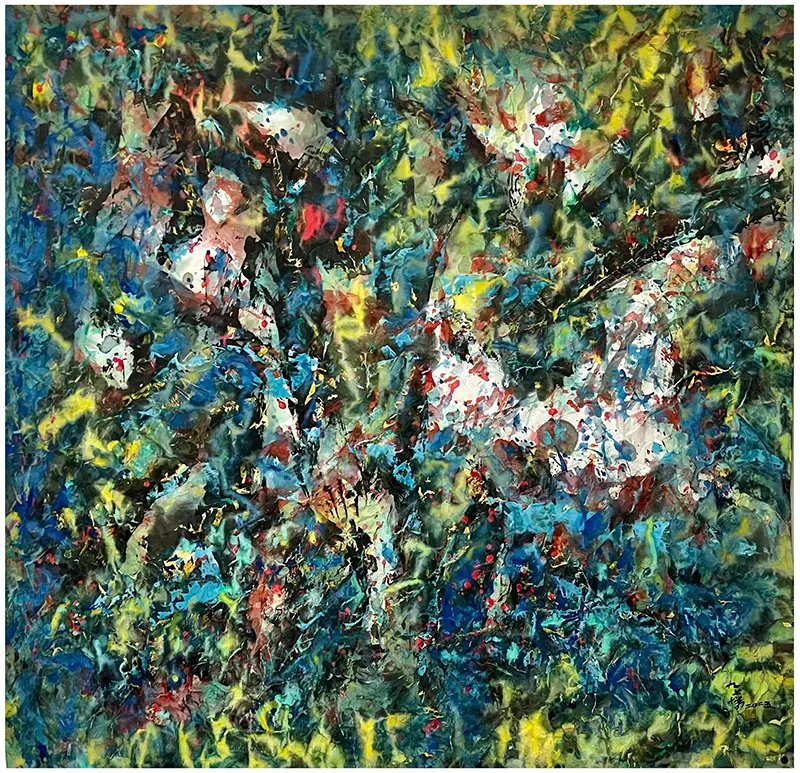
Verdure, 2025
The works featured in this essay will be presented in Landscape Within, the inaugural exhibition of Unique East Art in Los Angeles.