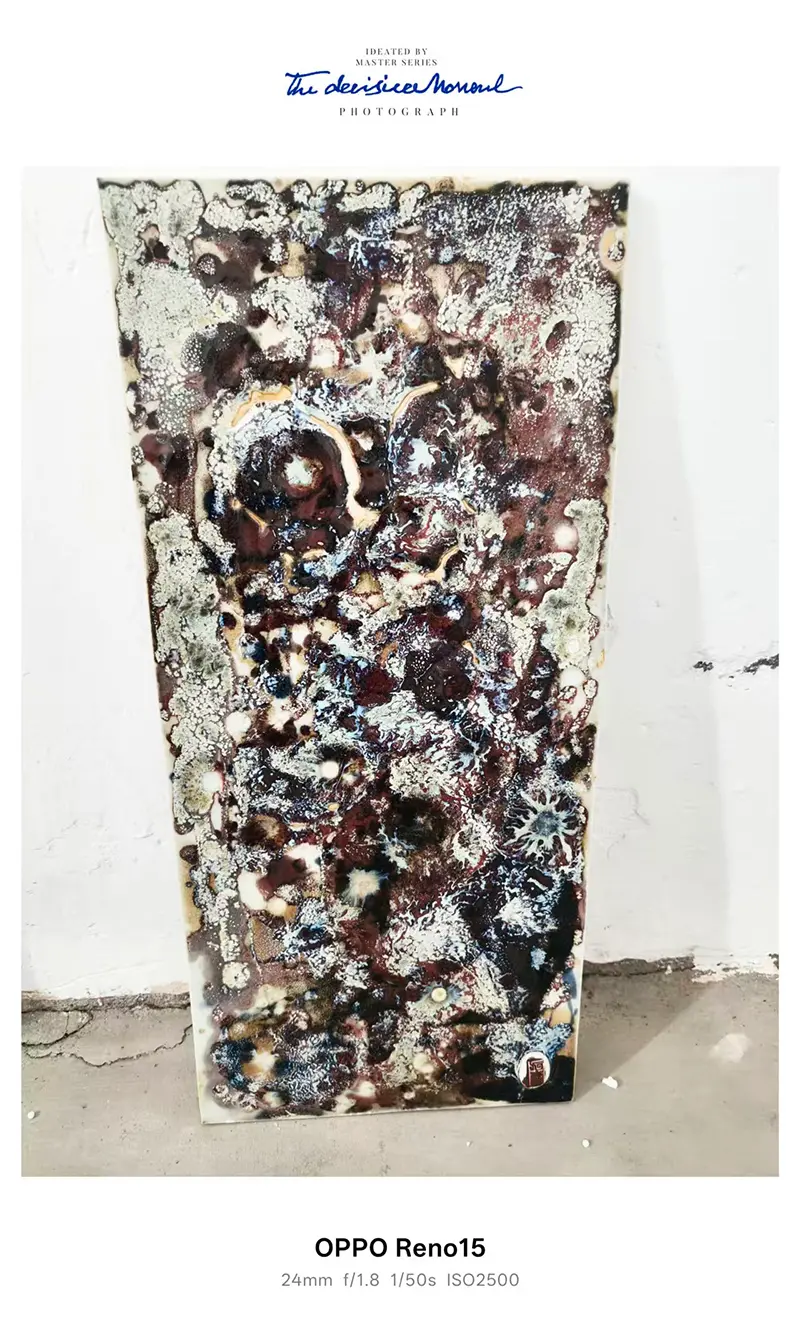
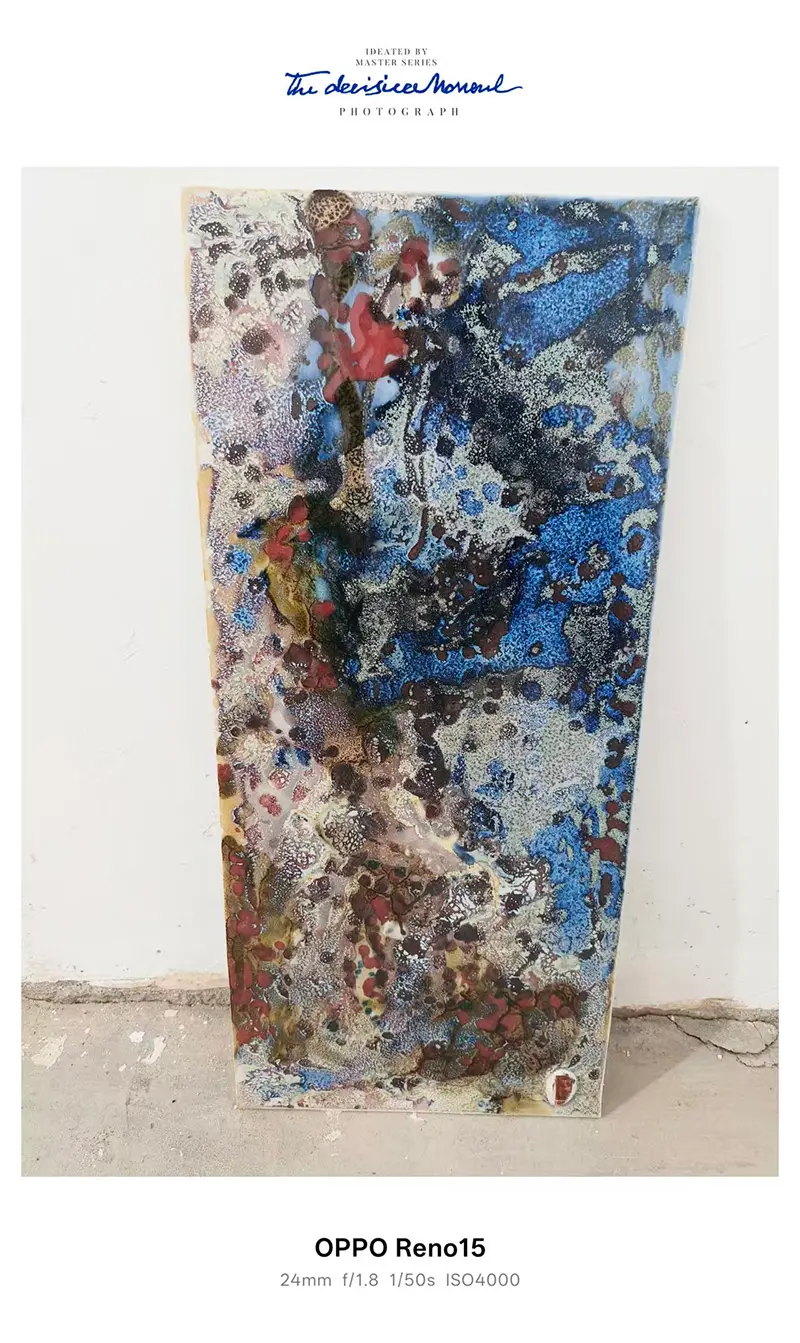
Using glaze as ink, chaos becomes heaven-made.
True art is never a matter of deliberate imitation, but rather the symbiosis of spirit and medium. When the philosophical core of Senxiangism encounters the fire-forged destiny of Jingdezhen’s 1300°C high-temperature glaze porcelain panels, a Senxiangism work is no longer merely an image upon paper. It becomes a tangible embodiment of spirit, jointly solidified by earth, glaze, and fire.
Senxiangism has always moved between figuration and abstraction. It neither caters to the rigidity of realism nor indulges in the emptiness of abstraction. Instead, it draws upon the forms of nature, conceals inward thought, and establishes a spiritual realm. Its principle lies in the coexistence of deliberate shaping and spontaneous emergence, and in the unity of rational order and emotional flow.
The high-temperature glaze porcelain panel is precisely the ultimate material vessel for this philosophy. It preserves the craft traditions passed down through a thousand years in Jingdezhen, yet within the kiln it gives rise to an irreproducible uniqueness. In doing so, it perfectly carries forward the spiritual essence already embodied in Senxiangism works on xuan paper using traditional Chinese pigments: quiet contemplation, clarity emerging from chaos, and the mutual generation of emptiness and solidity.
I. Choosing the Vessel: Using Porcelain as the Ground of Philosophy
At the beginning of the creative process, low-temperature porcelain—light, fragile, and superficial in effect—is deliberately set aside. Instead, a Jingdezhen high-white-clay, high-temperature bisque-fired porcelain panel is selected as the foundation.
The body is formed with a medium-thick clay structure and bisque-fired at 1280°C. Dense in texture, highly stable, and exceptionally flat, it withstands repeated tempering in high-temperature kiln fire while firmly supporting the flow and accumulation of glaze. This minimizes deformation and cracking during firing and establishes the most reliable material foundation for spiritual expression.
The surface of the porcelain panel is not excessively polished. A subtle earthen texture is retained, and a thin layer of matte transparent base glaze is applied. This allows subsequent color glazes to adhere more effectively while preserving the warmth and simplicity of the clay itself. The base tones avoid excessive brilliance, favoring pale celadon, light gray, and milky white. Quiet, restrained, and spacious, they resemble the blank state of mind at the beginning of reflection—neither competing nor clamoring, but simply waiting for the infusion of glaze and fire.
II. Applying the Glaze: Using Glaze as Ink, Expressing the Movements of the Mind
The creation of a Senxiangism high-temperature glaze porcelain panel is never a craft assembly line based on copying a draft. Rather, it is an artistic expression in which “the inner image comes first, and the glaze follows.”
The entire process follows Senxiangism’s core principle of integrating controllable shaping with spontaneous accident. It rejects rigid and formulaic coloring. Instead, glaze becomes ink and the hand becomes the brush, allowing every fluctuation of thought and every depth of philosophical reflection to enter each movement of glaze application.
Laying the Ground: Quieting the Mind, Beginning in Chaos
The first stage employs water-assisted glaze breaking to establish the underlying field of color. Iron-based brown-gray, cobalt-based ink-blue, and copper-based dark green are selected—low-saturation, subdued tones that are neither ostentatious nor aggressive, resembling the confusion and stillness that dwell within the depths of thought.
When the glaze reaches a semi-dry state, the porcelain panel is gently tilted, allowing the colors to flow, diffuse, and merge naturally. Irregular layers of emptiness and solidity emerge. Some areas become dense and heavy, expressing the depth and persistence of contemplation. Others remain pale as mist, suggesting the lightness and distance of the mind. No rigid separation is imposed between color fields. They are allowed to permeate one another freely, echoing the dialectical coexistence of thought and philosophy, emptiness and fullness, chaos and clarity.
Shaping the Texture: Deliberate Gesture, Establishing the Image and Revealing the Mind
Once the underlying glaze begins to set, the process enters the stage of deliberate shaping. This is precisely where Senxiangism distinguishes itself from purely spontaneous glaze pouring.
Glaze is no longer left to flow unchecked. Instead, brushes are used to outline forms, glaze is built up in relief, and splashed gestures are adjusted upon the flowing textures, embedding spiritual veins within the work.
Dense glaze establishes visual focal points, like moments when thought suddenly erupts. Fine brush lines extend across the surface like continuous streams of reflection. Areas of exposed clay reveal the foundation beneath, resembling traces left behind in the search for truth through dispersing mist. Small amounts of crystalline glaze and crackle glaze are added sparingly—not in pursuit of completeness, but as final touches—allowing the surface to possess its own layers and breath.
Every stroke contains an inner order. Every accumulation carries a spiritual direction. No specific object is depicted and no fixed form is established. Only the image beyond the image and the meaning beyond the scene remain. The viewer encounters the glaze and senses a state of mind; encounters the texture and awakens to philosophical reflection. In this way, the principle is fully realized: meaning is born from image, and philosophy is hidden within the realm.
III. Entering the Kiln: Using Fire as Covenant, Achieving the Unique
The soul of a high-temperature glaze porcelain panel does not reside on the worktable where glaze is applied, but within the tempering of kiln fire. This is also what makes Jingdezhen craftsmanship so captivating: the process follows established procedures, yet the finished work can never be duplicated.
The rigorous procedures of high-temperature porcelain firing are strictly observed. Once the porcelain panel has fully air-dried, all moisture is removed from both body and glaze to prevent glaze shock and cracking. The panel is positioned in the middle-upper section of the kiln, where temperature distribution is even and the reduction atmosphere remains stable, ensuring pure color development and intact texture.
A gas kiln with a strong reduction atmosphere is used, reaching 1290–1300°C. The temperature curve is carefully controlled: moisture is gradually expelled, glaze steadily melts, colors are fixed through a holding period, and the kiln is then allowed to cool naturally.
Fire is the unknown, and it is also the source of surprise.
Within the kiln, glaze melts, flows, changes color, and crystallizes. The textures and colors prepared on the worktable undergo entirely new transformations under intense heat. Iron glaze becomes weighty like ancient wood. Cobalt glaze becomes tranquil like deep space. Copper glaze becomes warm like aged moss. Crackles emerge naturally. Crystals quietly bloom. The traces of movement are permanently fixed by fire.
No two works can ever be exactly the same. Every kiln transformation, every diffusion of color, and every crack is a unique dialogue between fire and glaze, a singular spiritual imprint.
This is precisely what accords with the essence of Senxiangism: art is never mechanical reproduction, but a unique creation jointly completed by spirit and nature. The discipline of craftsmanship preserves the foundation of art; the accidents of kiln fire endow art with its soul.
IV. Becoming the Vessel: Thought Settles into Porcelain, Philosophy Endures in Fire
The moment a work emerges from the kiln, the transformation from inner image to visible phenomenon upon the porcelain panel is truly complete.
Viewed from afar, the entire porcelain panel appears calm and majestic. Its tones are deep and restrained. Emptiness and solidity interweave, while density and openness remain balanced. There is no clamorous color and no painstaking figuration, yet the work possesses a force that strikes directly at the heart. Like a silent forest of thought, it contains countless reflections and settles the clarity of worldly understanding.
Viewed up close, layers of glaze overlap one another. Textures rise and recede with subtle richness. Flowing glaze taces, delicate incised marks, natural kiln transformations, and the warmth of the clay body reward sustained contemplation. Every detail invites prolonged attention.
It is not a cold craft object. It is an artistic vessel with warmth, breath, and thought. Earth is the foundation. Glaze is the state of mind. Fire is the tempering. Thought is the core. Philosophy is the realm.
The craft of Jingdezhen porcelain panel painting has always emphasized rigorous procedure and reproducible methods. The creative practice of Senxiangism, however, faithfully observes the strict requirements of high-temperature glaze porcelain while breaking through the limitations of mechanical replication. It perfectly integrates individual spirit, artistic philosophy, and the heaven-made transformations of kiln fire.
Using porcelain as paper, glaze as ink, and fire as brush, it transforms invisible contemplation and profound philosophical reflection into an enduring visual embodiment. It does not cater to vulgarity, follow fashion, or repeat itself. Instead, it leaves upon the porcelain panel an eternal imprint unique to the language of Senxiangism:
“Thought reaching toward heaven and earth, philosophy hidden within the ten thousand forms.”
This is what may be called “Si-Zhe” (Thought-Philosophy): the art of earth and fire, the resonance of heart and image, and the most sincere and pure manifestation of Senxiangism within the medium of high-temperature glaze porcelain panels.