1. Obsessing over “likeness” — the realist trap
Whether in classical oil painting or meticulous gongbi painting, the core question is always: Does it look like the object? Whose hand is steadier? Whose eye is sharper? In the end, what is being competed over is craftsmanship.
2. Obsessing over “form” — the compositional/abstract trap
Whether Mondrian or Kandinsky, the core question becomes: Is it beautiful? Is the composition strong? Whose sense of form is stronger? Whose color arrangement is more refined? In the end, what is being competed over is design ability.
3. Obsessing over “emotion” or “taste” — the expressionist/literati trap
Whether Van Gogh or Bada Shanren, the core question becomes: Does it have flavor? What people call “interest,” “elegance,” “awkwardness,” or “naivety” is, in fact, a projection of the artistic persona. Whoever has the more distinct artistic personality, whoever expresses emotion more compellingly, wins. In the end, what is being competed over is performance, temperament, or talent.
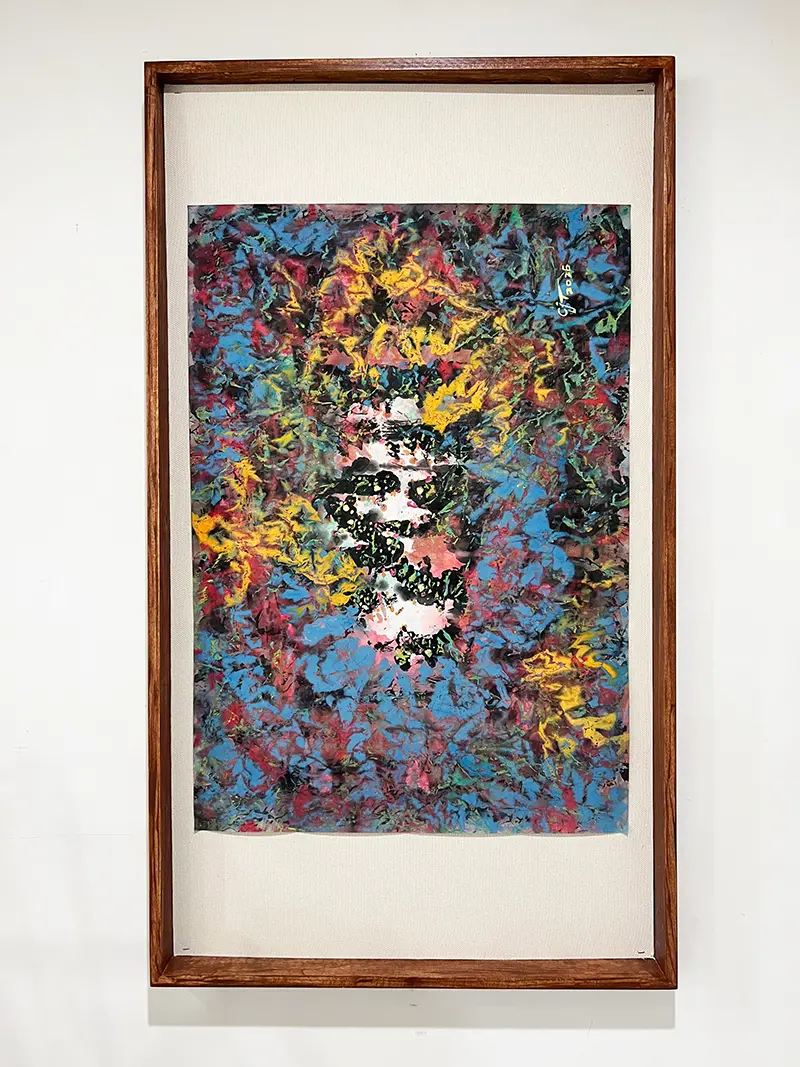
Senxiangism seeks to leap beyond these three traps and create a fourth dimension: state itself as the work.
What Senxiangism attempts to address is the original chaotic state of life.
It does not describe objects; therefore, one does not see specific mountains, waters, flowers, or birds.
It does not reinforce predetermined forms; it rejects fixed composition, insisting on “non-premeditated creation.”
It does not sell emotion. “Interest,” “elegance,” and “awkwardness” are all human-defined labels, all forms of attachment to the self. Senxiangism emphasizes the suspension of intention precisely in order to break through this attachment.
So what is it?
It is a kind of manifestation.
It is like taking a long-exposure photograph of the night sky or observing cell division under a microscope. It is not something “created” by the artist in the conventional sense. Rather, the artist provides an environment—paper, ink, water—and allows the energies of the universe, or of the subconscious, to flow out on their own.
Now that AI art has become popular, people have discovered that machine-generated images possess a certain non-human beauty. Although Senxiangism is handmade, it emphasizes “non-intentionality,” which in some ways echoes the logic of AI generation: both allow the image to grow by itself, rather than having a human forcibly impose a shape upon it.
At this stage in the development of painting, Chinese viewers have grown tired of their own traditional ink painting, while Western viewers have also grown weary of abstraction. Audiences long for a completely new visual language.
Senxiangism responds to this longing through a unique and innovative Eastern pictorial language, creating a visual feast in which the breath of nature and all living things interweave.