It took me forty years to truly understand that sentence.
I first took up the brush at the age of ten and spent half a lifetime cultivating both skill and insight. I studied Fan Kuan, copied Shitao, and immersed myself in Huang Binhong. My mind became filled with the texture strokes, brush methods, ink methods, and compositional principles of those who came before me. Whenever I painted a traditional landscape, my hands were full of other people's language. It was like an assembled platter, like a collage of borrowed characters, like wearing clothes that belonged to someone else.
It looked good.
But it was not mine.I once thought that perhaps this would be my fate for life. How could I possibly meet the weight of a tradition built across a thousand years and carried forward by countless generations? That thickness of civilization was too immense. One person, one lifetime—I could never outrun it.
So I chose another road.
I began to dismantle the format of painting.
Crumpling, splashing ink, folding, layered staining, overpainting. Line, hierarchy, weight, speed—none of it predetermined, none of it used to construct scenery. I let the paper speak for itself, let the ink move on its own, let the water flow where it would. I stood to one side, watching, like a farmer standing beside crops as they grow. When water was needed, I watered. When it was time to harvest, I harvested.
When it was enough, I stopped.
This is Senxiangism.
Some people ask:
Does this have a method?
Yes. But it is not a method that can be written down.
The methods of the ancients are like roads: already paved, ready for you to walk upon. My method is like water: whatever vessel it enters, it takes that shape. What I feel today is not the same as what I felt yesterday. What I feel in this very moment may be different again a little later, and the image responds instantly to that shift. One layer covers another differently from the previous painting—not because I am trying to innovate, but because this particular work has come to this point, and the heart says it must move this way.
I call this “half lucid, half bewildered.”
What is lucid is this: I know how to use the materials. I know what the painting lacks, and what it has in excess.
What is bewildered is this: I do not know what it will finally become, nor do I know precisely what the next step will be.If one is too lucid, the painting dies.
If one is too bewildered, the painting falls apart.The key is to remain in the middle—lucid enough to grasp the whole, bewildered enough to allow chance to occur.
A work is like fermentation. Slowly, it begins to take on a feeling of its own. It is not that the hand has become ripe; it is that the eye has ripened, the heart has ripened.
At what point is a painting “enough”? When it reaches that point, something sounds softly inside. It is not a literal sound, but a feeling—like water reaching fullness, like fruit coming ripe, like a road arriving at its end. One cannot explain it clearly, but one knows in that moment.
That is it. Stop.
This, perhaps, is one way of understanding what Shitao meant by “the method of no-method.” The method is no longer outside oneself; it is inside. There is no need to think about it anymore. The hand moves by itself. The eyes see by themselves. The heart knows by itself when to stop.
The method and I can no longer be separated.
A Senxiangism work bears no colophon, no calligraphy, and no traditional composition. One may not even be able to identify exactly what object is being painted.
This is the marriage of brush and ink.
The latest Senxiangism work: “Soul of the Earth”
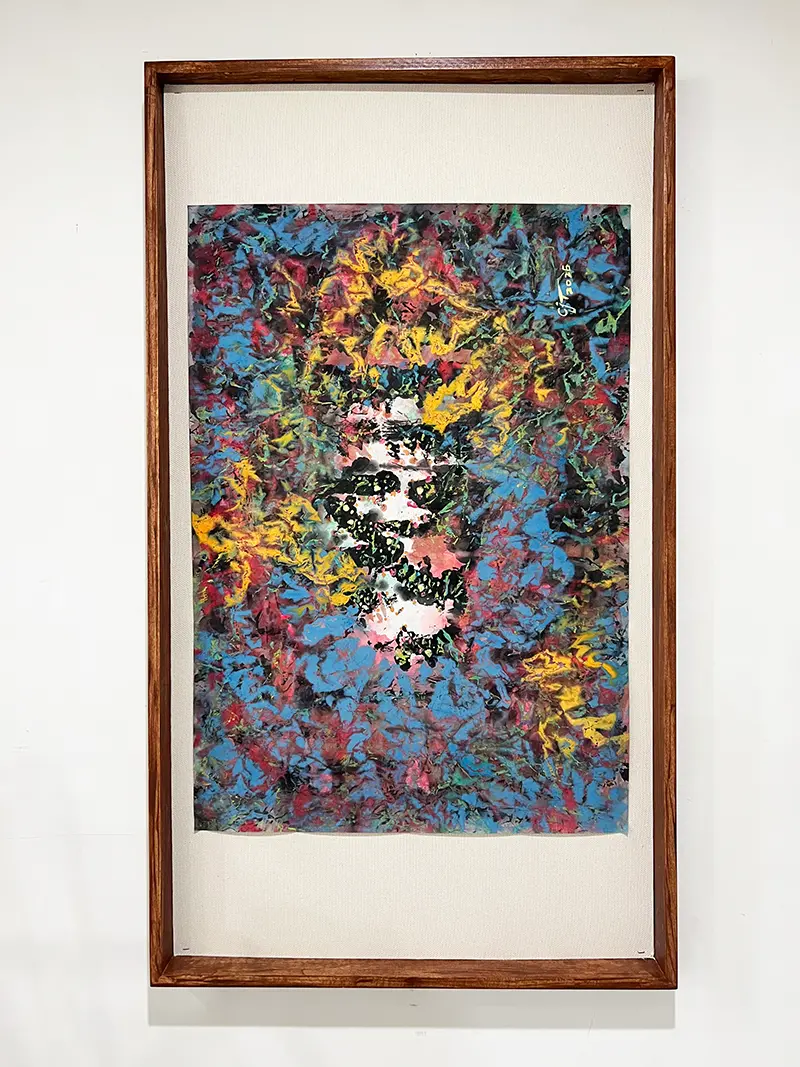
This is not a betrayal of tradition.
It is using the bones of tradition to grow flesh of one’s own.Shitao also said: “Brush and ink must follow the times.”
To follow the times does not mean running after them. It means, within one's own age, answering in one's own way a single question:
“How can painting still be painted?”
Artistic creation lies in one's self-interpretation and sincere expression within the living present of one's time. It should be one's own language—not a copy of someone else, not a patchwork of borrowed voices, not another person's shadow.Shitao said: “The method of no-method is the highest method.”
I think the highest method is this:
The method is in the hand, in the heart, in the tempering of life itself, and in that final moment when one knows—
“It is enough, and one stops.”