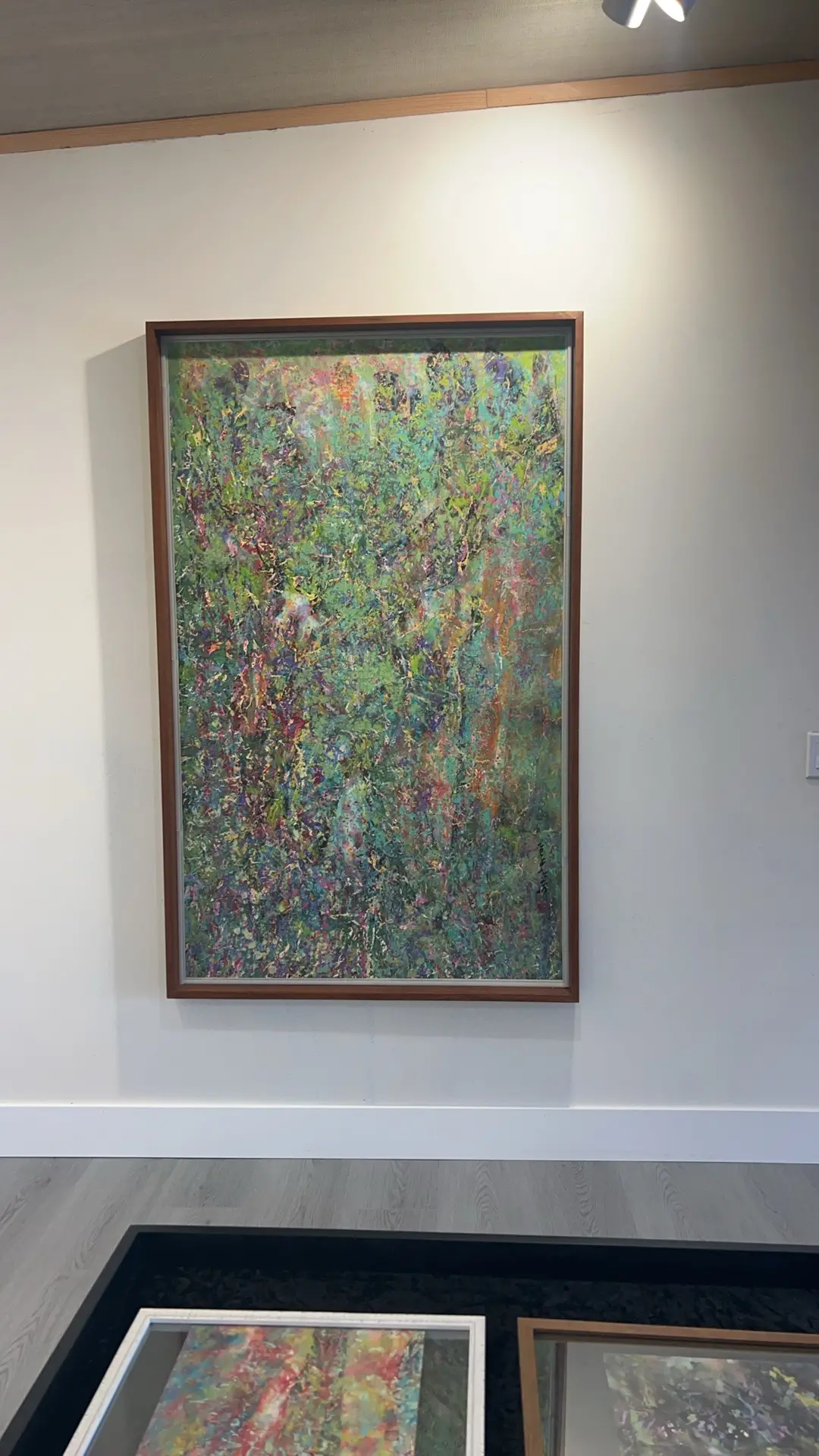
After decades spent before xuan paper, after traversing the formulas of the ancients and the methods of the masters, mountains, waters, flowers, and birds under the brush gradually become fixed patterns—where a peak should rise, where the ink should fall, where blankness should remain: all governed by established rules. At such a moment, the more refined the technique, the stronger the constraint; the more faithfully one paints, the farther one drifts from oneself.
Thus come weariness and agitation. What was once called self-cultivation begins to produce the opposite effect. One must turn away. Yet turning away is not betrayal; it is letting go.
Let go of representation.
Let go of the three distances.
Let go of the prescribed procedures of outlining, texture strokes, dotting, and washing.Let go of the prescribed procedures of outlining, texture strokes, dotting, and washing.
Paper may be crumpled. Ink may be splashed. Color may be layered again and again. The old rule that ink must not obstruct color, and color must not obstruct ink, may be broken. The order of first water then ink, or first ink then water, may be disrupted. There is no need to keep asking, What should I paint? One need only follow the flow of the present moment, allowing brush and material to respond to one another, until the painting itself speaks and says: “enough.”What is generated in this way belongs neither to the lineage of traditional Chinese landscape painting nor to the same path as Western abstraction. It retains the paper, ink, and color of Chinese painting, yet abandons the shell of formula. It arises from the painter’s intuition, yet does not end in the mere release of emotion. It creates an intermediate realm between control and chance—a place where every covering-over becomes a revision of what came before, and every layer accumulates the thickness of time.
This kind of painting I call “Senxiang.”
“Sen” is not simply the literal idea of a forest. It is the meaning carried by the character itself: birds, insects, trees, woods, and dense growth—an entire condition of life in which all things proliferate, interweave, and entangle. There is no hierarchy, no fixed path, only growth itself.
“Xiang” does not mean outward appearance or object-form. It is breath, atmosphere, the ten thousand phenomena, and also that which lies beyond form. It does not imitate the world; rather, it offers a field in which the world may reveal itself.
The essence of a Senxiang work lies not in what it depicts, but in how it is allowed to become itself.
It does not predetermine an outcome, and thus every work is a first time.
It does not repeat itself, and thus every work is unrepeatable.
Its value does not depend on likeness or unlikeness, refinement or roughness, but on whether the inner vitality of the image is self-sufficient—whether lightness and weight, emptiness and solidity breathe together; whether line and ink resonate in counterpoint; whether warm and cool colors respond to one another. When these formal elements form a closed field of energy, the work stands complete. It does not need to be interpreted. It only needs to be felt.This is an attempt to return painting to its source. Stripped of the burden of narrative, the shackles of formula, and the labels of schools and styles, what remains is simply the dialogue between painter and material, and the traces left by time upon the surface.
It is not a rebellion against tradition, but a digestion of tradition—digested to the point where it can be forgotten, forgotten to the point where freedom becomes possible.
The birth of “Senxiang” arises from a single awareness: that the art of painting should not end with the refinement of technique, nor remain confined within the inheritance of schools. When the painter realizes that there is no single right way to paint, this does not mean the abandonment of standards. Rather, it means arriving at another kind of standard—a standard measured by sincerity and guided by the truth of flow.
This path is destined to remain a minority path. For it offers no visual comfort zone and does not cater to established habits of seeing. It is like a narrow passage, one that can admit only those willing to lay down their preconceptions and meet the image with the full weight of their own lived experience.
Precisely because of this, it remains true.
What is true does not need to speak loudly.
It simply remains, waiting.“A solo exhibition of Senxiangism will be held at Unique Home Art Gallery in Los Angeles from March 15 to May 15, 2026."
Address: 653 S Melrose St, Placentia, CA 92870
Hours: Mon–Sat, 9 AM–3 PM