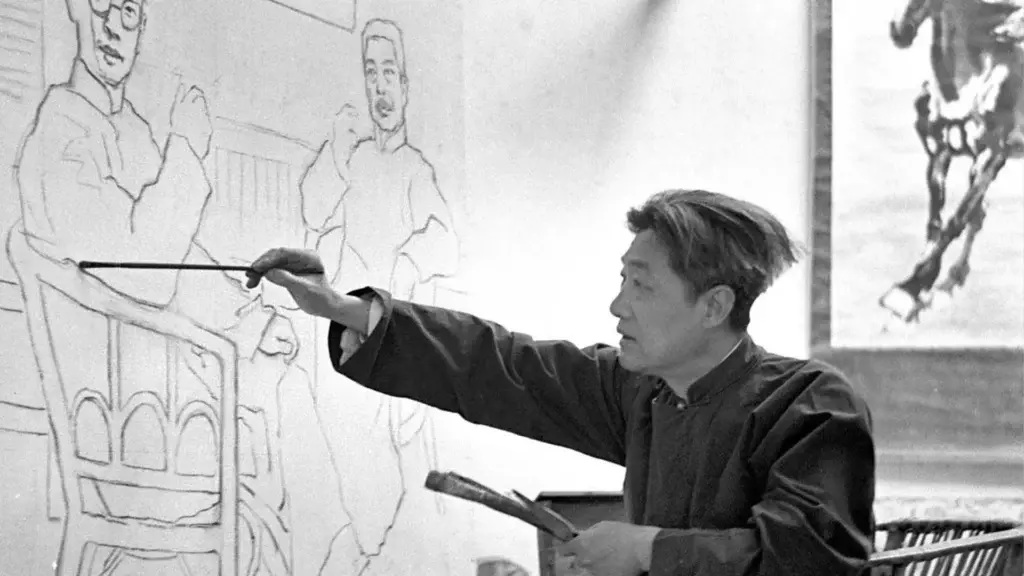
In the 1990s, at Xinhua Bookstore on Wangfujing in Beijing, I bought two books: Beihong and I by Jiang Biwei, and The Life of Xu Beihong by Liao Jingwen. I was still young then. I only felt that Xu Beihong’s paintings were truly powerful, grand in spirit and magnificent in vision.
Later, near Jishuitan, I had the fortune of meeting Ms. Liao Jingwen at the Xu Beihong Memorial Museum, where I listened to her speak about Beihong’s past. Only now, slowly, do I begin to understand the greatness of Xu Beihong: it lies in realism. How can one person become a piece of history? Because he simultaneously played three roles: the terminator of an old era, the founder of a new system, and the initiator of a school.
In 1927, Xu Beihong returned from France. He was thirty-two years old. During the previous eight years he had spent in Europe, he studied realism under Pascal Dagnan-Bouveret, painted the human body in Berlin, copied the classics in Paris, and forged a mastery of form unmatched by his Chinese contemporaries. But what he brought back to China was not merely a set of skills. It was also a judgment: Chinese painting, if it was to be saved, had to turn toward realism.
In 1918, in his lecture at Peking University titled Methods for the Reform of Chinese Painting, he began by saying, “The decline of Chinese painting has reached its extreme today.” The words sounded harsh, but he was speaking the truth. For three hundred years, literati painting had hidden itself in the study, imitating antiquity. Figure painting had reached the point where “fingers lacked joints, arms and legs were like straight tubes”—it could no longer even paint human beings convincingly.
His prescription consisted of sixteen words:
Preserve what is good in the ancient methods; continue what is on the verge of extinction; reform what is inadequate; supplement what is insufficient; and absorb what is valuable from Western painting.
These sixteen words became the foundation for almost everything later called “the fusion of Chinese and Western art.”
But Xu Beihong was not limited to words.
In 1930, The Five Hundred Warriors of Tian Heng appeared.
In 1931, "Jiu Fanggao" was completed.In 1931, Jiu Fanggao was completed.
In 1940, Yu Gong Moves the Mountain was painted.
Through these works, he proved that Western sketching, perspective, and anatomy could be used to paint Chinese stories and Chinese figures. These three paintings were among the earliest attempts at history painting in modern Chinese art history, and they became the source of much later thematic creation.
Even more important was his educational system.
After 1928, he successively taught at the Nanguo Art Academy, the Art Department of Central University, and the Art Academy of Beiping University. In 1946, he became president of the National Beiping Art School. In 1950, he became president of the Central Academy of Fine Arts. Across thirty years, he personally established a complete pedagogical order: sketching as the foundation of all plastic arts—this was the principle; the “New Seven Methods”—this was the structure; “rather square than round, rather awkward than clever, rather dirty than clean”—this was the methodology.
This system remains, to this day, the underlying foundation of most art academies in China.
He selected people without regard to faction or background. In 1928, in Beiping, he repeatedly visited Qi Baishi to invite him out of obscurity. At that time, Qi Baishi was already sixty-six and still stood at the margins of the Beijing art world. In 1930, in Nanchang, Xu encountered Fu Baoshi, recognized his talent, and immediately supported him in studying abroad. In 1931, he edited and wrote the preface for Album of Paintings by Qi Baishi, helping push this elderly man of carpenter origin onto the historical stage.
He also cultivated Wu Zuoren, Ai Zhongxin, and Feng Fasi, and together with Jiang Zhaohe formed the influential “Xu-Jiang system”—the orthodox line of realist ink figure painting.
In 1933, he brought an exhibition of modern Chinese painting to Paris. The French government purchased twelve works and established a special Chinese Painting Gallery in the National Museum of Foreign Art. This was the first time Chinese art entered Western cultural consciousness as an integrated presence.
In 1929, he debated Xu Zhimo and openly opposed modernist painting. This incident has remained controversial. Some say he was conservative and narrow-minded. But viewed within the context of that era, his choice had its own logic: when the nation was in peril, art first had to be an art the people could understand.
Shao Dazhen’s judgment was fair: rather than calling it a personal limitation, it would be better to say that it was determined by the age.
On September 26, 1953, Xu Beihong died of a cerebral hemorrhage at only fifty-eight. He died too young, but his system had already taken root. Later, Ms. Liao Jingwen donated more than 1,200 of his works and over 1,000 pieces from his collection to the state. I once asked her why. She said, “Beihong often said that art belongs to the nation.”
Why has he been called half of modern Chinese art history?
Because from 1918 to 1953, across thirty-five years, he was present at every key turning point in Chinese art’s movement from tradition toward modernity. He was the introducer, the founder, the educator, and the polemicist; he was also the one who discovered Qi Baishi and Fu Baoshi.
After him, Chinese art either followed the road he opened, or sought its own road by opposing him. But either way, it could not bypass him.
On July 21, 1949, the Chinese Artists Association was founded, with Xu Beihong as its first chairman. From that point on, academic academy painters, official association painters, and folk painters began to become clearly differentiated.
Three Kinds of Painting, One Shared Displacement
Xu Beihong’s generation used half of modern history to answer the question: where should Chinese painting go?
Seventy years later, no one asks this question anymore—not because an answer has been found, but because the question itself has shattered across the ground.
It has shattered into three kinds of painting: painting by academic academy artists, painting by official artists with association backgrounds, and painting by folk artists. Each has its own logic, its own people, and its own way of surviving.
What may be called the “metaphysical displacement of art within reality” is precisely the fracture, misalignment, and mutual non-recognition within today’s art world.
First, there are the academic academy painters.
Most of them teach in art academies, hold doctoral degrees, write theoretical essays, and participate in academically curated exhibitions. Their core logic is academic legitimacy. What one paints and how one paints must have a theoretical explanation behind it; it must be able to enter the context of art history.
What they fear most is being told that their work “looks like so-and-so,” because resemblance implies a lack of contribution. So they constantly experiment, constantly search for new language, constantly use their works to write footnotes to themselves.
Their living environment is this: within the system, they have salaries and will not starve. But to stand out, they must compete within the academic circle. Papers, exhibitions, projects, professional titles—there is a complete evaluation system, not very different from science and engineering. Their works rarely enter public view, and they do not particularly care whether the public understands them. Recognition by peers is more important than recognition by the market.
Then there are the official artists, those with backgrounds in the Artists Association.
Most of them work in painting academies or hold positions within artists’ associations. They have participated in the National Art Exhibition and have won awards. Their core logic is institutional recognition. What one paints and how one paints must be able to pass exhibition review, conform to mainstream aesthetics, and be suitable for hanging in great halls and museums.
What they are best at is thematic creation: major historical events, heroic figures, magnificent mountains and rivers. Their paintings are solid, rigorous, and understandable.
Their living environment is this: resources within the system are abundant, but competition is intense. Every five years, at the National Art Exhibition, countless people wait for that one prize. Once selected or awarded, one’s status rises: one can be promoted, obtain projects, and enter painting academies. Their works have channels for state collection and also a market, with fairly high prices, though fluctuations can be significant. Their greatest anxiety is simple: in the next National Art Exhibition, will they still be selected?
Finally, there are the folk painters.
This “folk” category is slightly different from the already successful independent artist—that is the tip of the pyramid. Far more people are found in the body and base of the pyramid. They are not inside the system and not inside academies. They rely on galleries, auctions, online shops, and livestreaming to sell paintings.
Their core logic is market survival. What one paints and how one paints depends on what buyers like. Landscapes, flowers and birds, Buddhist images, auspicious subjects—whatever sells is the hard truth. They do not speak of academics, nor of mainstream legitimacy. They speak only of market conditions.
Their living environment is the freest, and also the cruelest. It is free because no one controls what they paint. It is cruel because if the paintings do not sell, they cannot survive. After the pandemic, many galleries collapsed, and online traffic became increasingly expensive. Those who survived were either older painters who had established reputations early, or younger newcomers who understood short-video platforms and self-media.
Their works range from a few hundred to tens of thousands in price, but in the eyes of the general public, the identity of “painter” is often not very different from that of a decorator.
Three kinds of painting, three kinds of logic.
The academy pursues height.
The official system pursues correctness.
The folk market pursues visibility.
Each has its own sky, each has its own people, but between them there is almost no communication.Each has its own sky, each has its own people, but between them there is almost no communication.
The academy says the official painters are too old-fashioned, and the folk painters too vulgar.
The official painters say the academy painters are incomprehensible, and the folk painters unserious.The official painters say the academy painters are incomprehensible, and the folk painters unserious.
The folk painters say the first two are pretentious and do not understand the market.
Three logics, three systems of language, three worlds. Occasionally, they meet at art fairs, biennales, or exhibitions of various levels, glance at one another, and then each goes his own way.
This is the metaphysical displacement of art within reality.
The “metaphysical” refers to what art should originally possess—the spiritual, the transcendent, the questioning of essence. But reality gives it no face. The academy artist must fill out forms. The official artist must submit to review. The folk artist must sell goods.
Every painter once believed he had come here to make art. But after making it for long enough, he discovers that he is actually working on professional titles, relationships, and traffic. He wants to return to painting itself, only to find that he can no longer paint for the sake of painting itself. The painting is filled with survival strategies, identity anxiety, and market expectations.
What is even more displaced is this: between these three logics, there is no common artistic standard by which to judge.
You say a painting is good—but in what sense is it good?
Academically good?
Thematically good?
Commercially successful?
The three standards dismantle one another. The result is that everyone believes he is right, everyone believes the others are wrong, and everyone feels that this age is unworthy of his painting.The three standards dismantle one another. The result is that everyone believes he is right, everyone believes the others are wrong, and everyone feels that this age is unworthy of his painting.
What Xu Beihong faced in his time was a question: how can Chinese painting be revived?
What today’s painters face is a predicament: whose painter am I, exactly?
No one can please the academy, the system, and the market at the same time. So each person can only choose one road, and then accept the price of that road. The academy artist accepts marginality. The official artist accepts review and censorship. The folk artist accepts vulgarization.
What an artist fears most is not hardship, but division: the thing you want to paint and the thing you are required to paint are forever not the same thing.
This is what displacement means: moving back and forth among these divisions, unable to find a place to stand.
But then again, these three kinds of painting do share one thing in common.
They are all seeking recognition.
The academy seeks recognition from the academic circle.
The official artist seeks recognition from the system.
The folk artist seeks recognition from the market.
Once recognized, one feels grounded. Without recognition, one continues to drift.
Xu Beihong was recognized because he answered the question of an era. Today, no one can answer that question, because there are too many questions, and they are fighting one another.
Therefore, perhaps displacement is not temporary. Perhaps it is the normal condition of artists in this age.
What one can do is find one’s own narrow path among these three logics, then walk on.
Do not look back.
Do not look to either side.