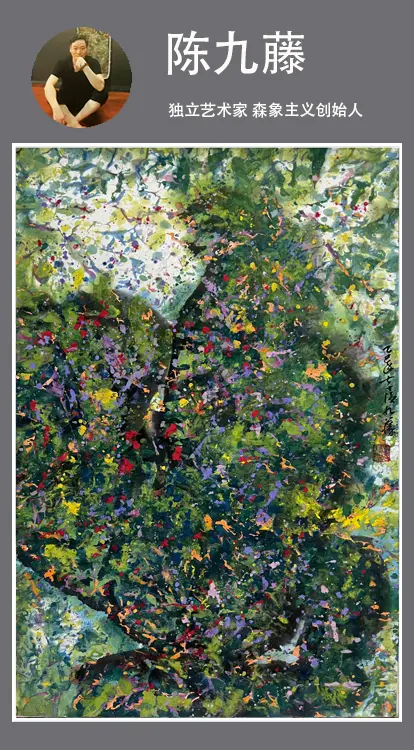
The following is a briefly organized record of a conversation with Mr. Chen Jiuteng on November 30, 2025:
Oil painting is rigid and hard, almost like painting a wall. Whatever softness it possesses is achieved purely through the spreading and smearing of oil pigment. Canvas remains canvas; material remains material. It is too scientific, too rational. That is why Western oil painting eventually could no longer continue along its original path. Later came Cubism, Impressionism, and after that abstraction. This was the route it followed.
But why is abstraction so difficult in Chinese painting? Because once Chinese painting moves toward abstraction, it can easily become detached from its materials—from the paper itself, from the nature of the medium. That creates another difficult problem. So these are not only academic questions, but also technical ones. This is why, today, whether in China or the West, it has become extremely difficult for true masters to emerge: these barriers are extraordinarily hard to break through.
In the same way, traditional Chinese painting has also reached the end of its road. It can no longer evolve into something new, because it continues to cling to the limited inheritance left by the ancestors, relying on that old capital alone. Yet in the present age, people’s minds can no longer become still, and the market has also weakened. Sooner or later, traditional Chinese painting may enter the museum.
Therefore, for those who truly practice Chinese painting, each year will become harder than the last. It will become increasingly difficult to continue. It was from this awareness that I realized I had to change. I had to innovate.
This change did not happen suddenly. Five or six years ago—even seven or eight years ago—I had already begun thinking about transformation. But to truly transform, one must first discover one’s own sensitivity and then bring it into expression. Only then can something genuinely new emerge.
Senxiangism is precisely what has been developed over these past few years.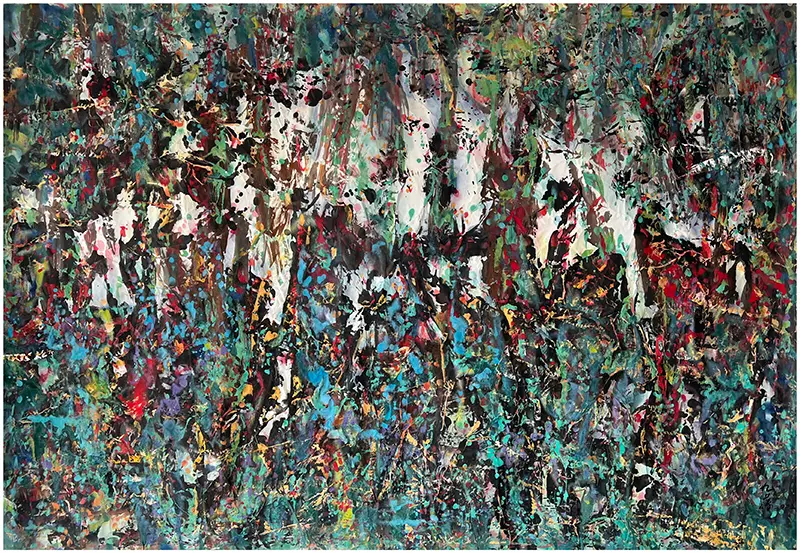
Chen Jiuteng: New Works of Senxiangism
Chinese painters cannot surpass the West in oil painting. Historically, oil painting entered China through two main lines: one from Italy and Western Europe, the other from Russia, especially the former Soviet Union. After these styles were introduced, those who studied them may have gained somewhat stronger technical skills, but after all, they were learning a foreign system, often only partially understood. When they returned to China and taught generation after generation of students, the language inevitably changed. It gradually became a way of painting oil painting through the logic of Chinese painting.
Therefore, Chinese oil painting is actually very difficult to sell abroad. When it does sell well, it is often because of political associations or because certain figures were elevated by particular historical conditions. Eventually, it acquires a financial attribute, and once art becomes financialized, people naturally rush toward it. But that does not necessarily mean the oil painting itself has reached great artistic height. In the end, oil painting is still something Western artists understand more deeply.
This creates a very complicated problem. A person who has painted oil painting often can no longer truly return to Chinese painting, because their mode of thinking has changed. Meanwhile, a painter trained in Chinese painting often cannot bring out the inner qualities of Western oil painting, and instead produces a kind of Chinese-style oil painting. So it becomes something grafted, something cloned. In the end, it is difficult to make it work, because the medium and the cultural soil do not fully belong to each other.
The making of an artwork is itself a deeply contradictory process. If the process of production takes too long, one’s sensitivity and passion begin to fade. But when one’s sensitivity and inner impulse are at their strongest, if the process of making cannot keep up, then the image cannot be fully released, and the inner world cannot be properly expressed.
This contradiction is precisely what formed two different material languages in Eastern and Western painting. Chinese painting, with its use of xuan paper, possesses a powerful sense of writing. Its capacity for self-expression is very strong, but its capacity for prolonged fabrication is comparatively weaker. Oil painting, by contrast, is painted on stretched canvas or board. Because the surface is taut and stable, its capacity for construction is very strong; it allows for carving, polishing, layering, and slow refinement over time.
Yet in this very process, the emotional force of immediate self-expression becomes weakened. The passion and sensitivity of the moment gradually diminish, because passion is, after all, something that arises in an instant. If one slows down too much, it flashes past and disappears.
Therefore, Chinese and Western painting are fundamentally different. Their differences are not only cultural or technical; they are visibly present in the very surface of the painting itself.
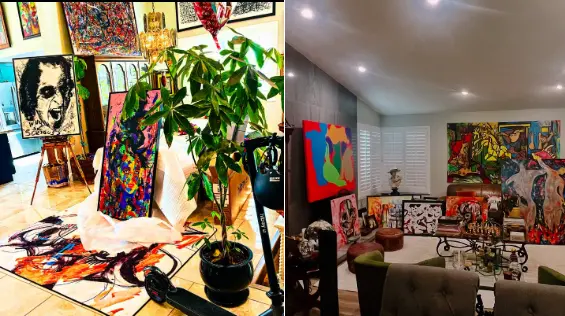
Therefore, Western painting may be said to possess an excess of rationality, but a deficiency of sensibility. Chinese painting, by contrast, possesses an abundance of sensibility, yet lacks somewhat in rational construction. In Chinese painting, whether one paints the sky, flying birds, or water, there is often a great expanse of blankness. This blankness allows the viewer to imagine a continuous space beyond what is visibly painted. This is what we call "emptiness". And emptiness is the greatest space of all. It belongs to a philosophical system.Western painting, however, tends to fill the picture completely. If a space is left empty, if the canvas remains unpainted, it seems uncomfortable. It must be filled. Even when depicting the sky, Western painting often insists on painting the sky itself rather than allowing blankness to remain. This is because it has more than enough rationality, but not enough sensibility.
Yet the present age offers an opportunity for Chinese painting. After all, China’s economic strength has grown significantly, and cultural influence will inevitably follow. Whether for a nation or a people, economic power forms the foundation behind cultural expansion. Once economic strength rises, its culture begins to circulate outward; and once that culture becomes visible, many will begin to follow, imitate, and respond to it. Therefore, in the present moment, the international market for Chinese culture will likely become increasingly promising. This is the direction of the trend. We must recognize the trend and judge the times accordingly. So when both Chinese and Western painting seem to have reached a difficult impasse, that very moment may become an opportunity for the innovator.