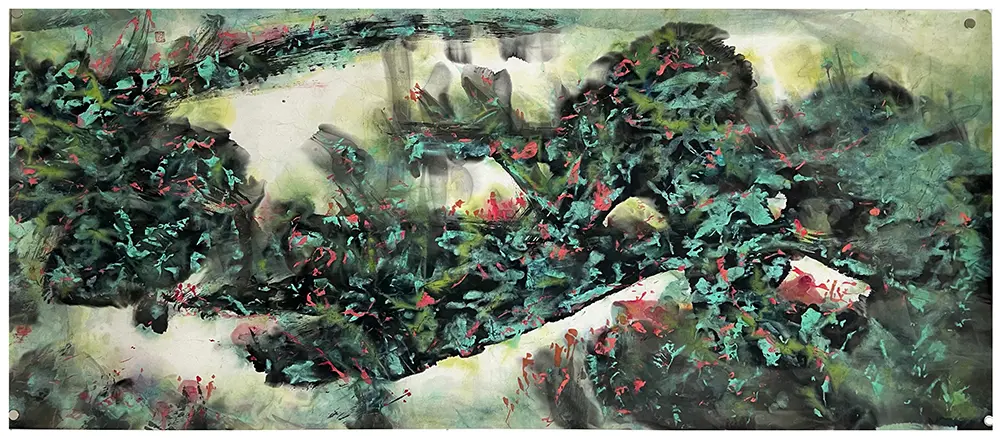
I. Conception: Breaking from the Cocoon, Toward the Myriad Forms of the Dense and Living World
My **Senxiangism** is not a fabrication born from nothing. Rather, it is the inevitable arrival of a fifty-three-year journey through brush and ink—a moment reached when the path runs to the water’s end, and one sits to watch the clouds rise.
Traditional landscape painting is the mother tongue of my art. I have delved deeply into the grand and upright spirit of the Song masters’ mountains and valleys, and have been intoxicated by the sparse, distant elegance of Yuan brushwork. It is a complete, rigorous, even awe-inspiring system. Yet the deeper I immersed myself in it, the more I felt a kind of “sweet suffocation.” The landscapes painted by the ancients were ideal dwellings within the hearts of literati of their time—ordered paradises where one could walk, gaze, wander, and reside. But I, today, live in an age of exploding information, compressed time and space, and restless, scorched inner life. The “nature” we face is no longer Wang Wei’s WangChuan, nor Huang Gongwang’s Fuchun Mountains. More often, it is an inward, fragmented, even wounded spiritual landscape.
To stop merely at imitating the ancients would be no different from using the wine cup of the past to pour out one’s own grief; in the end, the wine would inevitably lose its true flavor. The soul of art lies in **life**, not imitation. Therefore, I must **break through**. This is not betrayal, but the necessary departure of a grown child from the ancestral house, in order to open a territory of his own. The conception of **Senxiang** begins here—**to return to the source of creation, and allow landscape to “grow” once more beneath my brush.**
**Sen** is the primordial state in which all things begin to grow: an undivided, chaotic, yet vigorous field of life. It refuses to be confined by a single perspective; it is the totality of all possibilities.
**Xiang** does not refer to the visible form of any particular mountain or river. Rather, it is the **Xiang** of “the great image has no form”—the ultimate truth generated through the collision between the essence of nature and the inner nature of the self. It is the **primordial spirit** of landscape.
Thus,**Senxiangism** is **both a creative philosophy and a worldview**. It advocates that art should return to a state of becoming as spontaneous, interwoven, competitive, and symbiotic as a forest, in order to capture and reveal that essential **inner image** which transcends concrete outward form.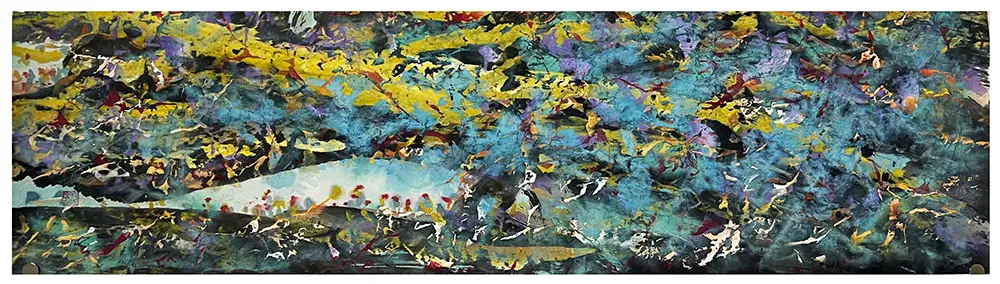 II. Thought: A Paradigm Revolution from “Constructing Scenery” to “Generation”
The thinking of **Senxiangism**, however, is one of **generation**. I relinquish absolute sovereignty over the picture plane, entrusting part of the creative force to the material itself, and to the uncontrollable nature of chance.
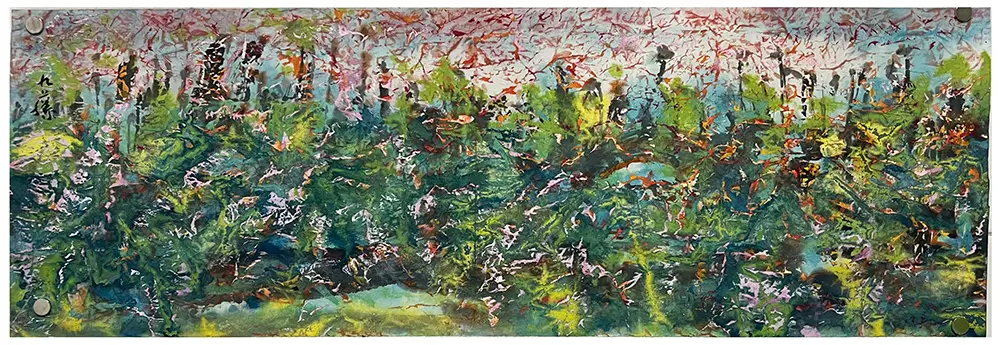
**Crumpling and folding are the starting point from which I “generate” landscape.** A flat sheet of raw xuan paper represents a kind of “nothingness” waiting to be depicted. But when I crumple and fold it, I give it a **geological structure** that precedes brush and ink. These creases are the paper’s **memory**, the **bones** of the image about to be born. They naturally carry tension, traces of history, as if billions of years of crustal movement had been condensed into a small surface. From this very first step, the dimension of time has already entered the act of creation.
**The free breathing and restless movement of heavy color constitute the process of “generation.”** Although I use traditional Chinese painting pigments—azurite, malachite, cinnabar, and ochre—the method of application is no longer the traditional practice of repeated fixing and dyeing. I allow intense colors to flow, collide, seep, and accumulate freely among the ravines and peaks formed by the folds. Water and ink, color and binder, interact within the paper’s microscopic terrain, producing marks that are unexpected, yet somehow inevitable. This process I call **free breathing**. The paper **inhales**, greedily absorbing the nourishment of color; the color **exhales**, freely expanding the territory of its own life.
In this process, my role shifts from that of a **builder** to that of a **guide** and **interlocutor**. I am by no means passive; rather, I respond to each opportunity that the image itself brings forth, using all of my learning, intuition, and inner feeling. According to the movement of color, I may follow its momentum and intensify a certain tendency; or I may break the situation open and introduce a new variable. This is a form of **collaboration between heaven and human**, a creation completed through the deep interaction between **self** and **matter**. The final image is the crystallization of my inner nature and the material nature of the medium, formed in a state of creative flow.
III. Philosophy: A Contemporary Source of the Heart Rooted in “Clarifying the Heart to Contemplate the Way”
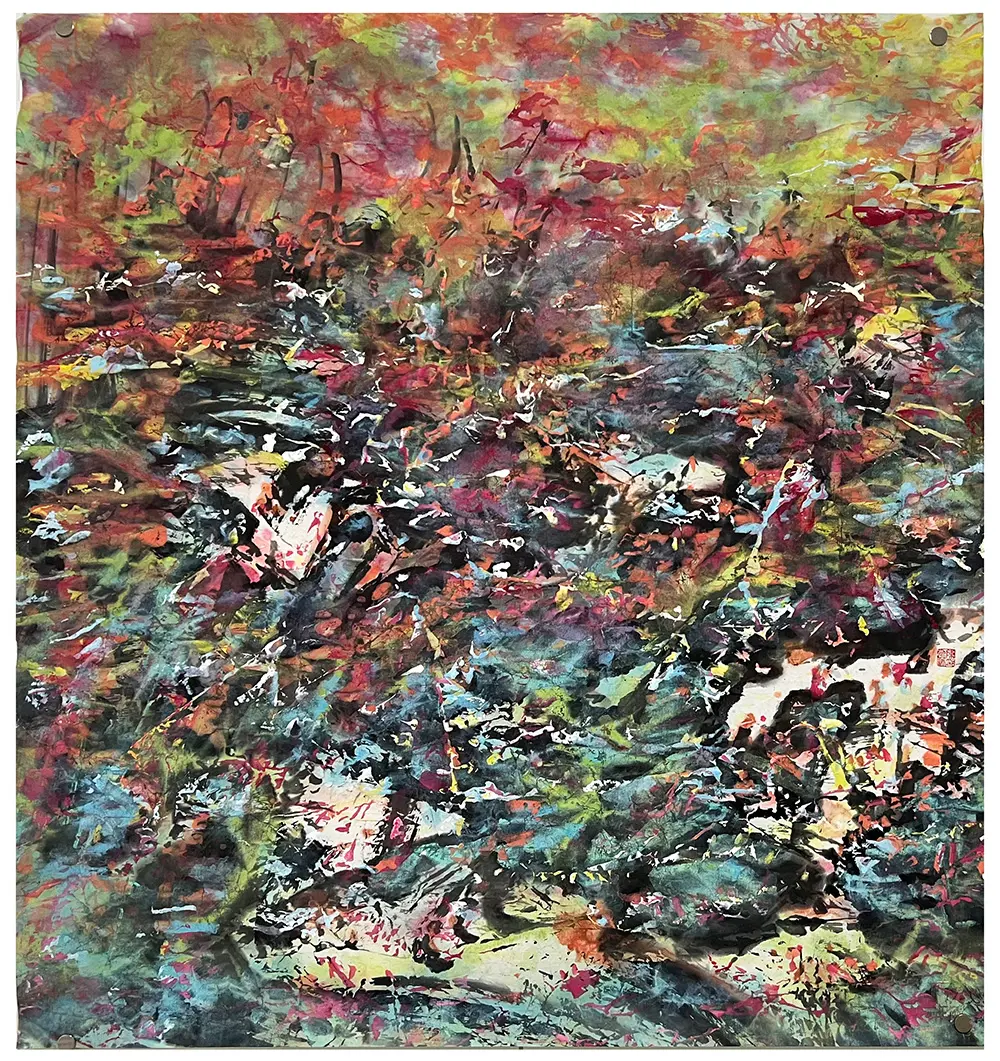
Though my method may appear radical, its philosophical roots are deeply planted in the fertile soil of Chinese tradition. **Senxiangism** is not a tree without roots; it is the evolution and echo, within a contemporary context, of **“clarifying the heart to contemplate the Way”** and **“drawing the source from within the heart.”**
**“Clarifying the heart” is the prerequisite.**
If the mind is filled with fixed formulas, utilitarian aims, and anxiety, it cannot enter that state of creative flow in which one dances with the material. I must first empty myself—letting go of attachment to technique and calculation of style—so that the heart may become like a clear mirror and still water. Only then can it reflect the subtlest movements of the material and the truest temperament of color. At this moment, **crumpling paper** and **pouring color** are no longer acts of disorder, but a form of cultivation: the practice of “reaching utmost emptiness and guarding deep stillness,” and the realization of “doing nothing, yet leaving nothing undone.”
**“Contemplating the Way” is the purpose.**
What I contemplate is not the outward form of mountains and rivers, but the inner **Way of generation**. The formation of creases, the merging of colors, the spreading of water traces—all the movements of this microscopic world embody the fundamental laws of the universe: the mutual birth of yin and yang, and the unity of contradiction. My painting ultimately seeks to reveal the path along which this **Way** moves. It is the momentary manifestation of the **Way** upon xuan paper.
**“Drawing the source from within the heart” is the final return.**
Zhang Zao’s words reveal the true essence of art. However the external world of nature may change, it must ultimately return to an inner verification of the heart. Although **Senxiang** emphasizes the autonomy of material, every brilliant fold and every breath-like movement of color is still a projection of my own **heart-source**. My anxiety, my longing, my stillness, and my grandeur are all recorded honestly and unmistakably in this silent conspiracy with the material. The image is my **inner image**—the direct presentation of my state of being.
Therefore, **Senxiangism** is Chinese in spirit through and through. With a language that may appear “modern,” even “abstract,” it continues to speak of the most essential ancient propositions in Chinese philosophy: **the unity of heaven and humanity**, and **the interpenetration of mind and matter**.
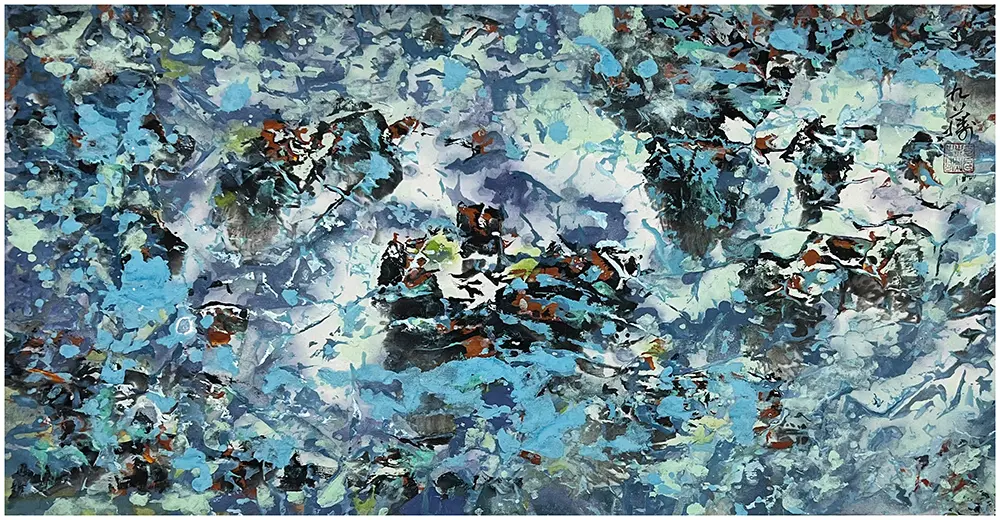
Within the expressive system of **Senxiang**, the choice of **heavy color** is by no means a simple attempt to cater to visual impact; rather, it arises from an inner necessity.
Ours is an age in which the senses are overstimulated. The pale elegance and ethereal quietude of light ink and soft color can certainly create the refined realms pursued by the ancients. Yet at times, they are no longer sufficient to bear the intensity and complexity of contemporary lived experience. We need a visual language with greater weight and stronger penetrating force, one that can correspond to the clamor and splendor within our inner world.
Mineral colors such as azurite, malachite, and cinnabar carry within themselves the soul of the earth and the weight of time. Their saturation and intensity possess a primordial force that speaks directly to the human heart. In the generative process of **Senxiang**, heavy color is no longer merely used to depict blue-green mountains and waters; it becomes the protagonist itself, the direct vessel of emotion and energy. The collision and fusion of these colors are themselves a drama of color, a silent symphony.
Yet the crucial foundation remains this: **all of my explorations are firmly rooted in the essential materials of Chinese painting—raw xuan paper, brush and ink, and traditional Chinese pigments.**
The absorbency and permeability of raw xuan paper cannot be replaced by any other kind of paper. It is precisely these qualities that make the “breathing,” “seeping,” and “restless movement” of color possible, giving rise to a unique, mist-like, ever-changing texture. I still use wolf-hair and goat-hair brushes. When guiding color and outlining spiritual resonance rather than external form, the irreplaceable sensitivity and elasticity of the brush ensure that the spirit of **writing** continues. The steadiness and translucent nature of traditional Chinese pigments are also entirely different from Western paints; they allow the image, even in its intensity, to retain an Eastern inwardness and radiance.
Here, the concept of **brush and ink** is expanded. It is no longer limited to the specific techniques of outlining, texture strokes, dotting, and washing. Instead, it is elevated into an overall capacity **to command material and guide the movement of the heart**. My grasp of the folds, my judgment and intervention in the flow of color—these are, in a larger sense, my **brush**. The rich layers and resonances formed by color and water traces upon raw xuan paper—these are my **ink**.
This is the nirvana and rebirth of the spirit of brush and ink in the contemporary age.
V. The Present: Offering a “Forest to Dwell In” for a Restless Age
The birth of **Senxiangism** is also a response to the aesthetic needs of the present.
In an age flooded with images and thinned of meaning, the human spirit longs for depth and density. Refined, instantly legible sweetness can no longer satisfy the hunger of the soul. People need to encounter, within art, a truth capable of conversing with their own complex inner lives—even a truth marked by a certain sense of wound and trauma.
At first glance, works of **Senxiang** may appear chaotic, powerful, even oppressive. Yet upon closer viewing, their inner order, breath-like rhythm, and the rich texture of the material itself gradually form a powerful **field of energy**, or a **space for contemplation**. They do not offer simple answers. Instead, they invite the viewer to enter and immerse themselves, to interpret and feel through their own lived experience, and in doing so, to find a quietness and resonance that belong to them alone.
It is a spiritual **deep forest** into which modern people may step and dwell—a forest filled with the tension and vitality of life.
## Conclusion: Still on the Road
At fifty-three, I have, for myself, moved beyond the greenness of imitation and surpassed the confusions of middle age, entering a golden period of creation in which one may “follow the heart’s desire without overstepping the bounds.”
**Senxiangism** is not the end of a style, but a living organism still growing, continually evolving.
I am still on the road, continuing to crumple, fold, pour, and layer. In every breath and every restless movement, I converse with ancient brush and ink, resonate with the spirit of the present, and welcome the next new inner image emerging from the dense myriad forms of existence.
This path leads into the depths of tradition, and also toward the infinity of the future.
My **Senxiangism** is not a fabrication born from nothing. Rather, it is the inevitable arrival of a fifty-three-year journey through brush and ink—a moment reached when the path runs to the water’s end, and one sits to watch the clouds rise.
Traditional landscape painting is the mother tongue of my art. I have delved deeply into the grand and upright spirit of the Song masters’ mountains and valleys, and have been intoxicated by the sparse, distant elegance of Yuan brushwork. It is a complete, rigorous, even awe-inspiring system. Yet the deeper I immersed myself in it, the more I felt a kind of “sweet suffocation.” The landscapes painted by the ancients were ideal dwellings within the hearts of literati of their time—ordered paradises where one could walk, gaze, wander, and reside. But I, today, live in an age of exploding information, compressed time and space, and restless, scorched inner life. The “nature” we face is no longer Wang Wei’s WangChuan, nor Huang Gongwang’s Fuchun Mountains. More often, it is an inward, fragmented, even wounded spiritual landscape.
To stop merely at imitating the ancients would be no different from using the wine cup of the past to pour out one’s own grief; in the end, the wine would inevitably lose its true flavor. The soul of art lies in **life**, not imitation. Therefore, I must **break through**. This is not betrayal, but the necessary departure of a grown child from the ancestral house, in order to open a territory of his own. The conception of **Senxiang** begins here—**to return to the source of creation, and allow landscape to “grow” once more beneath my brush.**
**Sen** is the primordial state in which all things begin to grow: an undivided, chaotic, yet vigorous field of life. It refuses to be confined by a single perspective; it is the totality of all possibilities.
**Xiang** does not refer to the visible form of any particular mountain or river. Rather, it is the **Xiang** of “the great image has no form”—the ultimate truth generated through the collision between the essence of nature and the inner nature of the self. It is the **primordial spirit** of landscape.
Thus,**Senxiangism** is **both a creative philosophy and a worldview**. It advocates that art should return to a state of becoming as spontaneous, interwoven, competitive, and symbiotic as a forest, in order to capture and reveal that essential **inner image** which transcends concrete outward form.
II. Thought: A Paradigm Revolution from “Constructing Scenery” to “Generation”
The creative thinking of traditional landscape painting centers on the idea of **constructing scenery**. With mountains and valleys already formed within the mind, the painter organizes
composition, texture strokes, and washes upon a two-dimensional surface, constructing a legible three-dimensional space rich in meaning. This is a kind of **creation under highly rational control**.
The thinking of **Senxiangism**, however, is one of **generation**. I relinquish absolute sovereignty over the picture plane, entrusting part of the creative force to the material itself, and to the uncontrollable nature of chance.
**Crumpling and folding are the starting point from which I “generate” landscape.** A flat sheet of raw xuan paper represents a kind of “nothingness” waiting to be depicted. But when I crumple and fold it, I give it a **geological structure** that precedes brush and ink. These creases are the paper’s **memory**, the **bones** of the image about to be born. They naturally carry tension, traces of history, as if billions of years of crustal movement had been condensed into a small surface. From this very first step, the dimension of time has already entered the act of creation.
**The free breathing and restless movement of heavy color constitute the process of “generation.”** Although I use traditional Chinese painting pigments—azurite, malachite, cinnabar, and ochre—the method of application is no longer the traditional practice of repeated fixing and dyeing. I allow intense colors to flow, collide, seep, and accumulate freely among the ravines and peaks formed by the folds. Water and ink, color and binder, interact within the paper’s microscopic terrain, producing marks that are unexpected, yet somehow inevitable. This process I call **free breathing**. The paper **inhales**, greedily absorbing the nourishment of color; the color **exhales**, freely expanding the territory of its own life.
In this process, my role shifts from that of a **builder** to that of a **guide** and **interlocutor**. I am by no means passive; rather, I respond to each opportunity that the image itself brings forth, using all of my learning, intuition, and inner feeling. According to the movement of color, I may follow its momentum and intensify a certain tendency; or I may break the situation open and introduce a new variable. This is a form of **collaboration between heaven and human**, a creation completed through the deep interaction between **self** and **matter**. The final image is the crystallization of my inner nature and the material nature of the medium, formed in a state of creative flow.
Though my method may appear radical, its philosophical roots are deeply planted in the fertile soil of Chinese tradition. **Senxiangism** is not a tree without roots; it is the evolution and echo, within a contemporary context, of **“clarifying the heart to contemplate the Way”** and **“drawing the source from within the heart.”**
**“Clarifying the heart” is the prerequisite.**
If the mind is filled with fixed formulas, utilitarian aims, and anxiety, it cannot enter that state of creative flow in which one dances with the material. I must first empty myself—letting go of attachment to technique and calculation of style—so that the heart may become like a clear mirror and still water. Only then can it reflect the subtlest movements of the material and the truest temperament of color. At this moment, **crumpling paper** and **pouring color** are no longer acts of disorder, but a form of cultivation: the practice of “reaching utmost emptiness and guarding deep stillness,” and the realization of “doing nothing, yet leaving nothing undone.”
**“Contemplating the Way” is the purpose.**
What I contemplate is not the outward form of mountains and rivers, but the inner **Way of generation**. The formation of creases, the merging of colors, the spreading of water traces—all the movements of this microscopic world embody the fundamental laws of the universe: the mutual birth of yin and yang, and the unity of contradiction. My painting ultimately seeks to reveal the path along which this **Way** moves. It is the momentary manifestation of the **Way** upon xuan paper.
**“Drawing the source from within the heart” is the final return.**
Zhang Zao’s words reveal the true essence of art. However the external world of nature may change, it must ultimately return to an inner verification of the heart. Although **Senxiang** emphasizes the autonomy of material, every brilliant fold and every breath-like movement of color is still a projection of my own **heart-source**. My anxiety, my longing, my stillness, and my grandeur are all recorded honestly and unmistakably in this silent conspiracy with the material. The image is my **inner image**—the direct presentation of my state of being.
Therefore, **Senxiangism** is Chinese in spirit through and through. With a language that may appear “modern,” even “abstract,” it continues to speak of the most essential ancient propositions in Chinese philosophy: **the unity of heaven and humanity**, and **the interpenetration of mind and matter**.
Within the expressive system of **Senxiang**, the choice of **heavy color** is by no means a simple attempt to cater to visual impact; rather, it arises from an inner necessity.
Ours is an age in which the senses are overstimulated. The pale elegance and ethereal quietude of light ink and soft color can certainly create the refined realms pursued by the ancients. Yet at times, they are no longer sufficient to bear the intensity and complexity of contemporary lived experience. We need a visual language with greater weight and stronger penetrating force, one that can correspond to the clamor and splendor within our inner world.
Mineral colors such as azurite, malachite, and cinnabar carry within themselves the soul of the earth and the weight of time. Their saturation and intensity possess a primordial force that speaks directly to the human heart. In the generative process of **Senxiang**, heavy color is no longer merely used to depict blue-green mountains and waters; it becomes the protagonist itself, the direct vessel of emotion and energy. The collision and fusion of these colors are themselves a drama of color, a silent symphony.
Yet the crucial foundation remains this: **all of my explorations are firmly rooted in the essential materials of Chinese painting—raw xuan paper, brush and ink, and traditional Chinese pigments.**
The absorbency and permeability of raw xuan paper cannot be replaced by any other kind of paper. It is precisely these qualities that make the “breathing,” “seeping,” and “restless movement” of color possible, giving rise to a unique, mist-like, ever-changing texture. I still use wolf-hair and goat-hair brushes. When guiding color and outlining spiritual resonance rather than external form, the irreplaceable sensitivity and elasticity of the brush ensure that the spirit of **writing** continues. The steadiness and translucent nature of traditional Chinese pigments are also entirely different from Western paints; they allow the image, even in its intensity, to retain an Eastern inwardness and radiance.
Here, the concept of **brush and ink** is expanded. It is no longer limited to the specific techniques of outlining, texture strokes, dotting, and washing. Instead, it is elevated into an overall capacity **to command material and guide the movement of the heart**. My grasp of the folds, my judgment and intervention in the flow of color—these are, in a larger sense, my **brush**. The rich layers and resonances formed by color and water traces upon raw xuan paper—these are my **ink**.
This is the nirvana and rebirth of the spirit of brush and ink in the contemporary age.
The birth of **Senxiangism** is also a response to the aesthetic needs of the present.
In an age flooded with images and thinned of meaning, the human spirit longs for depth and density. Refined, instantly legible sweetness can no longer satisfy the hunger of the soul. People need to encounter, within art, a truth capable of conversing with their own complex inner lives—even a truth marked by a certain sense of wound and trauma.
At first glance, works of **Senxiang** may appear chaotic, powerful, even oppressive. Yet upon closer viewing, their inner order, breath-like rhythm, and the rich texture of the material itself gradually form a powerful **field of energy**, or a **space for contemplation**. They do not offer simple answers. Instead, they invite the viewer to enter and immerse themselves, to interpret and feel through their own lived experience, and in doing so, to find a quietness and resonance that belong to them alone.
It is a spiritual **deep forest** into which modern people may step and dwell—a forest filled with the tension and vitality of life.
## Conclusion: Still on the Road
At fifty-three, I have, for myself, moved beyond the greenness of imitation and surpassed the confusions of middle age, entering a golden period of creation in which one may “follow the heart’s desire without overstepping the bounds.”
**Senxiangism** is not the end of a style, but a living organism still growing, continually evolving.
I am still on the road, continuing to crumple, fold, pour, and layer. In every breath and every restless movement, I converse with ancient brush and ink, resonate with the spirit of the present, and welcome the next new inner image emerging from the dense myriad forms of existence.
This path leads into the depths of tradition, and also toward the infinity of the future.